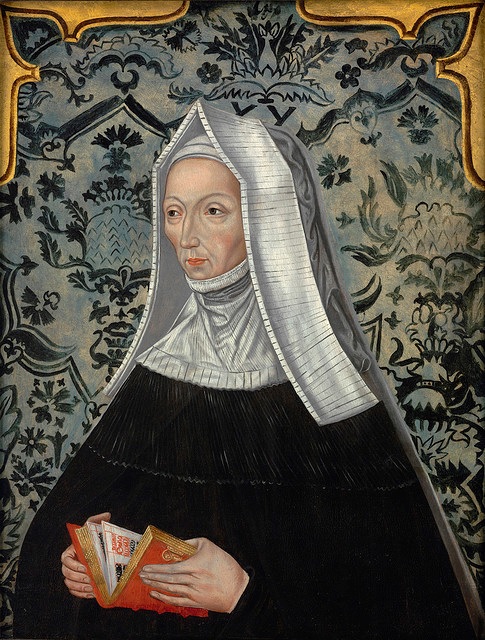
By all accounts Richard fought valiantly, as did his men. It just didn't work out for him, due to unfortunate circumstances. We could say "What if...?" What if Richard's horse hadn't gotten stuck in the boggy ground? What if Richard, who was only a sword's length away from Henry, had managed to kill him him, too? What if...

Although I was not in England celebrating the anniversary by witnessing the reenactment at the Bosworth Battlefield, I have been finding Richard in various ways all around me.
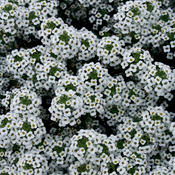 This summer I found a tiny flowering plant for my garden called "White Knight" Alyssum. Of course, I had to have some because who was the White Knight? Richard III of course!
My husband thought it funny that the garden company that produces this plant is called "Proven Winner." But I think Richard is a proven winner; despite having lost in battle, he is far more well-known and remembered today than Henry VII,
I recently went to the Frederik Meijer Gardens and Sculpture Park in Grand Rapids, Michigan. Two sculptures invoked thoughts of Richard for me.
 The first, called "Cabin Creek" by artist Deborah Butterfield. In the description about the sculpture, which I read after viewing it, the artist had hopes to create a form of an intelligent mare rather than a war horse. For me, though, not knowing this, I saw something else.
 The lines of the horse, with the strong horizontal piece in the mane area, was reminiscent of a sword. The horse's head is down, waiting for the indication from it's imagined rider to charge into battle. I could picture Richard sitting on this horse at the top of the hill, holding his sword at the ready, and watching Henry and his troops approach.
Another sculpture that inspired me was "Torso of a Knight." by artist Jean Arp, a significant artist in both dadaism and surrealism.
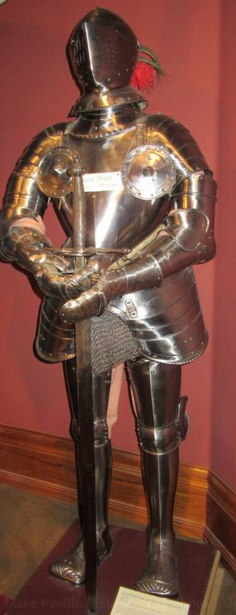 |
| Suit of Armour Grand Rapids Public Museum |
 We are meant to see a helmeted knight, in armour. He is standing, resolute and brave, watching for the battle to start. Knights in armour must stand straight and tall because of the rigidity of the metal. This reinforces the idea of firmness and strength, as well as some austerity.
What is our knight thinking while he is waiting for the battle to begin? He is probably thinking that some, even many of his soldiers will be injured or die, and even he may not make it. Richard had to be thinking of that as he contemplated the battlefield. The day would end with victory for one side or the other.
 When I am at home, I bravely fly my own Royal Standard. It reminds me of Richard every time I see it waving in the breeze.
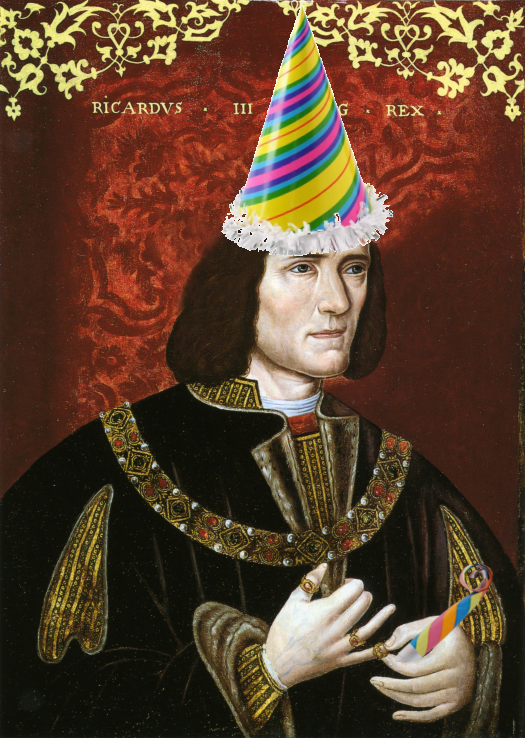 And at my own birthday, celebrated soon after the Battle Anniversary, who did I include in the decorations? King Richard, of course!