Facsimile of the First Folio
Notre Dame's Rare Books and Special Collections
During the month of January 2016, my workplace, the Hesburgh Library at the University of Notre Dame, has been fortunate to have been one of the first stops in the year-long journey of Shakespeare's First Folio, on loan from the Folger Shakespeare Library.
Shakespeare's First Folio
I have been fortunate myself to have been involved in the activities surrounding the Folio's arrival, events, and viewing. The Shakespeare at Notre Dame staff have been phenomenal in their plans and just being allowed to participate in them has been one of my biggest honours, next to the Reinterment, of course.
But with thinking about Shakespeare's life and death, it naturally means his play of Richard III is never far behind in my mind.
The Tragedy of Richard the Third was included in the First Folio. It was not one of the plays that was unique to the Folio, but because it was included, it is identified as important.
At the top of this blog entry you can see a facsimile of the Folio's first page of The Tragedy of Richard the Third with the famous speech, "Now is the Winter of our Discontent, made glorious Summer by this Son of Yorke;..." No matter what you feel for Shakespeare's Richard, this speech alone is enough to give you chills, its being one of the greatest dramatic speeches in the English language.
With the fabulous book, there was also a lovely collections of costumes in the library. These came from the Shakespeare at Notre Dame collection. And what costumes were included? Costumes from the 2013 Notre Dame Shakespeare Festival's last production of Richard III!
Richard III Costume
Shakespeare at Notre Dame
I was able to find out that this fall, the Actors from the London Stage are going to perform a new production of Richard III, but this production will include a female Richard! How will they do this? Will it make sense? I guess I will have to wait and find out.
Richard III's armour
from the 2013 Notre Dame Shakespeare Festival
In a previous post, I looked at portraits of Richard himself, all done some years after his death.
I have also been thinking of how Richard has been portrayed by others, mostly in that play by William Shakespeare. I don't want to bad-mouth the play since Will Shakespeare is also my cousin (1st cousin 15x removed through his mother's family), and there are some very fine speeches in it.
One of my favourites speeches makes Richard look a complete bad guy, the Epitome of Evil:
"But then I sigh, with a piece of Scripture
Tell them that God bids us to do evil for good;
And thus I clothe my naked villainy
With odd old ends stolen out of Holy Writ;
And seem a saint, when most I play the devil." Richard III, Act 1, Scene 3
Of course, this play was written during the height of the Tudor dynasty, and so there was no chance for Richard to ever be made to look good.
I was recently at the Art Institute of Chicago and visited their latest special exhibit, Ireland: Crossroads of Art and Design, 1690-1840, when what should I see:
Mr. Garrick as Richard III
by John Dixon, 1772
David Garrick by my favourite artist,
Thomas Gainsborough
David Garrick, the famous English actor, playwright, theatre manager, and producer, died in 1779, so this portrait was completed soon before his death. His appearance in Richard III was his most famous role.
David Garrick as Richard III,
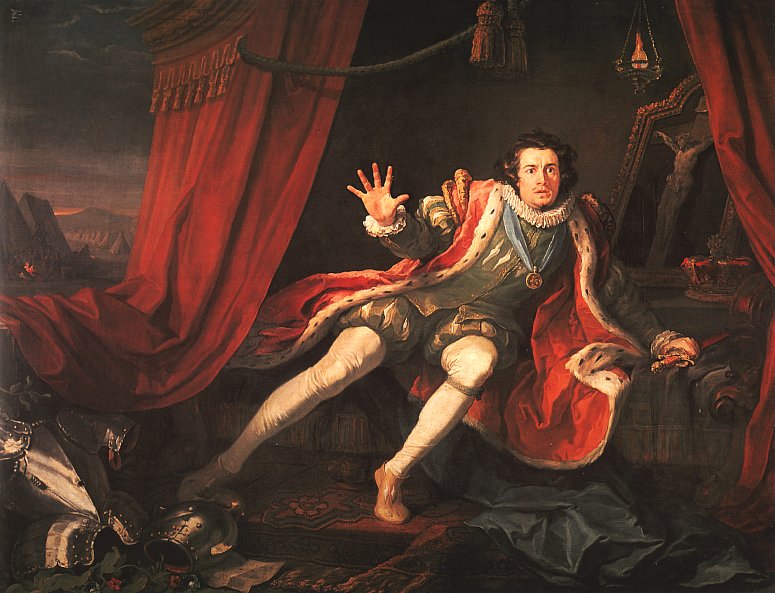
by William Hogarth, 1745
Another famous portrait of Garrick as Richard III was by his friend and famous artist, William Hogarth. This painting depicts a dramatic moment in the play on the eve of the Battle of Bosworth, in which Richard wakes up from a dream in which he has seen the ghosts of his murder victims.
I've been thinking of other famous portrayals of Richard III in Shakespeare's play that have coloured our opinion of him.
John Philip Kemble as Richard III
Painted by William Hamilton, 1783
Another famous actor who portrayed Richard was John Philip Kemble. This painting shows Richard in the play at the same moment as Hogarth's Garrick portrait, on the eve of the Battle of Bosworth, horrified by the dream images of his victims. But it is too late to redeem Richard.
John Philip Kemble (1757-1823), was a famous Shakespearean actor from a remarkably famous theatrical family. His sister was Sarah Siddons, the renowned actress of Drury Lane, painted by many of the era's foremost painters including Thomas Gainsborough, Sir George Reynolds, and . This is what
John Philip Kemble by artist
William Beechey, 1798-1799
Here is another famous painting of an actor portraying Richard:
Bogumil Dawison as Richard III
Painted by Friedrich von Amerling, 19th Century
This is an interesting portrait. The costume is unique, with the unusual headdress crown and the rich brocade on the cloak or coat, but what strikes us immediately is the scowl on the subject's face. It looks like Mr. Dawison is looking down slightly to make his brow more pronounced, a look of condescension and malignant plotting.
What do we know about this actor? Bogumil Dawison was born in Warsaw of Jewish parents in 1818. He went on stage at age 19. He was considered to be a "new type" of actor in Germany during his career, giving his roles more character and vivacity than had been seen before. He died in 1872.
One thing I notice from all of these portraits is that none of them has made Richard look particularly hunchbacked or malformed, although it is obviously part of the play. Perhaps this feature of Shakespeare's Richard was not emphasised in performances?
There have been several more modern portrayals of Richard III that have become famous. I think Sir Ian McKellen in the 1995 modernised film adaption springs to my mind first. This version, set in a fascist version of England in the 1930s, is brutal to Richard as a character. His manipulation of all around him is clear, Ian McKellen is brilliant in the part: sincere yet sneaky, painstakingly plotting, and by the end, we are glad that he's dead.
You can watch the entire film here:
Of course, nobody could forget the greatest modern Shakespearean actor, Sir Laurence Olivier. Besides his landmark roles as Hamlet and Henry V, he also portrayed King Richard in 1955. The costuming is lovely (authentic, I'm not sure), and his "This is the winter of our discontent" speech is unsurpassed in the history of this play, I feel. Richard in this example is portrayed as quite hunched back and having a withered arm, a malady I don't believe Richard had. Why the director gave it to him, I'm not sure, other than to increase our believability in his warped resentment of his physical condition and his malicious grudges of those around him. It's easier to dislike a maimed monster than a man with a slight hunch who is merely misunderstood.
The film is available on YouTube:
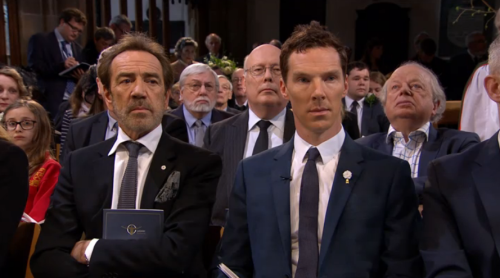
The last actor I will mention is one who played him in a 1998 production for the Royal Shakespeare Company and was also at the Reinterment, Robert Lindsay. He did not receive the most flattering reviews for his performance as the evil King. I don't know if he deserved the harsh reviews, but I certainly have enjoyed watching him in other period roles and wouldn't mind seeing him in his Richard III role.
Robert Lindsay as Richard III
Robert Lindsay & Benedict Cumberbatch
at the Royal Reinterment of King Richard


 I have been fortunate myself to have been involved in the activities surrounding the Folio's arrival, events, and viewing. The Shakespeare at Notre Dame staff have been phenomenal in their plans and just being allowed to participate in them has been one of my biggest honours, next to the Reinterment, of course.