Facsimile of the First Folio
Notre Dame's Rare Books and Special Collections
During the month of January 2016, my workplace, the Hesburgh Library at the University of Notre Dame, has been fortunate to have been one of the first stops in the year-long journey of Shakespeare's First Folio, on loan from the Folger Shakespeare Library.
Shakespeare's First Folio
I have been fortunate myself to have been involved in the activities surrounding the Folio's arrival, events, and viewing. The Shakespeare at Notre Dame staff have been phenomenal in their plans and just being allowed to participate in them has been one of my biggest honours, next to the Reinterment, of course.
But with thinking about Shakespeare's life and death, it naturally means his play of Richard III is never far behind in my mind.
The Tragedy of Richard the Third was included in the First Folio. It was not one of the plays that was unique to the Folio, but because it was included, it is identified as important.
At the top of this blog entry you can see a facsimile of the Folio's first page of The Tragedy of Richard the Third with the famous speech, "Now is the Winter of our Discontent, made glorious Summer by this Son of Yorke;..." No matter what you feel for Shakespeare's Richard, this speech alone is enough to give you chills, its being one of the greatest dramatic speeches in the English language.
With the fabulous book, there was also a lovely collections of costumes in the library. These came from the Shakespeare at Notre Dame collection. And what costumes were included? Costumes from the 2013 Notre Dame Shakespeare Festival's last production of Richard III!
Richard III Costume
Shakespeare at Notre Dame
I was able to find out that this fall, the Actors from the London Stage are going to perform a new production of Richard III, but this production will include a female Richard! How will they do this? Will it make sense? I guess I will have to wait and find out.
Richard III's armour
from the 2013 Notre Dame Shakespeare Festival
Essentially, medium Christine Hamlett of Northwich, Cheshire, was visiting Leicester Cathedral recently, wanting to pay her respects to King Richard, and she had a peaceful feeling in the cathedral which she attributed to Richard's presence. Having been there myself during the Reinterment, I can say there was a calm feeling there that day, too, although not being psychically inclined, I would not have attributed it only to Richard. I do like to think that he was there that day, however.
Anyway, she took some photographs and when she went back to look at them, there was Richard's face looking out from a stone slab in the floor! I think the stone slab in the picture is right outside the area where the tomb is located.
Why do you think Richard's face would be in that place and not closer to the tomb, either next to it or hovering over it? I would like to examine this slab myself. I suspect a lot of people will be headed to the Cathedral soon to do just that, all snapping photos to see if they can see Richard's ghost.
Another ghostly reference to Richard appeared in this article. In nearby Donington le Heath Manor House, a 700-year-old building near Leicester, some ghost hunters claimed they had recorded the actual voice of Richard speaking to them in the bedroom where he last slept!
Why would Richard be in Donington le Heath Manor House? One story is that he spent his last night there. Richard must have had several last nights, since he is also said to have stayed at the Blue Boar in town.
Richard III and the Ghosts
Henry Fuseli & William Blake, ca. 1806
I am a fan of stories of ghosts and haunted places. My favourite movies are all about haunted houses, hotels, ships, and people. So when I hear stories about my two favourite things--ghost stories and Richard III--combined together, I get very excited!
When is the next ghost hunt at Leicester Cathedral? I'm signing up!
Recently we celebrated the 530th anniversary of the Battle of Bosworth and the death of Richard III.
By all accounts Richard fought valiantly, as did his men. It just didn't work out for him, due to unfortunate circumstances. We could say "What if...?" What if Richard's horse hadn't gotten stuck in the boggy ground? What if Richard, who was only a sword's length away from Henry, had managed to kill him him, too? What if...
Although I was not in England celebrating the anniversary by witnessing the reenactment at the Bosworth Battlefield, I have been finding Richard in various ways all around me.
This summer I found a tiny flowering plant for my garden called "White Knight" Alyssum. Of course, I had to have some because who was the White Knight? Richard III of course!
My husband thought it funny that the garden company that produces this plant is called "Proven Winner." But I think Richard is a proven winner; despite having lost in battle, he is far more well-known and remembered today than Henry VII,
I recently went to the Frederik Meijer Gardens and Sculpture Park in Grand Rapids, Michigan. Two sculptures invoked thoughts of Richard for me.
The first, called "Cabin Creek" by artist Deborah Butterfield. In the description about the sculpture, which I read after viewing it, the artist had hopes to create a form of an intelligent mare rather than a war horse. For me, though, not knowing this, I saw something else.
The lines of the horse, with the strong horizontal piece in the mane area, was reminiscent of a sword. The horse's head is down, waiting for the indication from it's imagined rider to charge into battle. I could picture Richard sitting on this horse at the top of the hill, holding his sword at the ready, and watching Henry and his troops approach.
Another sculpture that inspired me was "Torso of a Knight." by artist Jean Arp, a significant artist in both dadaism and surrealism.
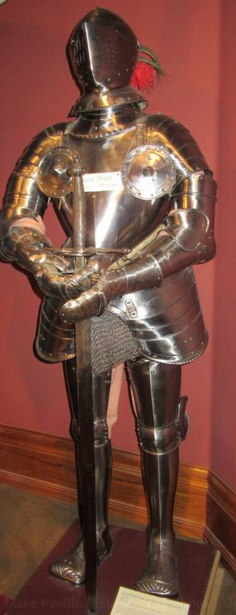
Suit of Armour
Grand Rapids
Public Museum
We are meant to see a helmeted knight, in armour. He is standing, resolute and brave, watching for the battle to start. Knights in armour must stand straight and tall because of the rigidity of the metal. This reinforces the idea of firmness and strength, as well as some austerity.
What is our knight thinking while he is waiting for the battle to begin? He is probably thinking that some, even many of his soldiers will be injured or die, and even he may not make it. Richard had to be thinking of that as he contemplated the battlefield. The day would end with victory for one side or the other.
When I am at home, I bravely fly my own Royal Standard. It reminds me of Richard every time I see it waving in the breeze.
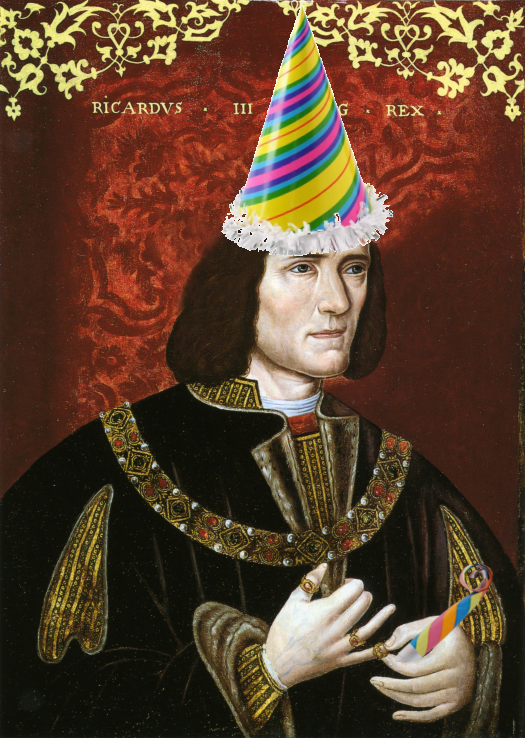
And at my own birthday, celebrated soon after the Battle Anniversary, who did I include in the decorations? King Richard, of course!
This past week, I finally did my presentations at the public library on Richard III. I did a Power Point presentation, including many links and photos. Of course it wasn't without technical difficulties. I can try to embed the presentation here:
This will provide you with the presentation and I think the links will work. I have lots of links to interviews, pictures, songs, and news stories done at the time.
I had about 25 people attend both presentations. They seemed really interested and asked great questions. At one of my presentations, the links would not work in the version of Power Point I was using, so I had to wing it. I was really surprised by how much I could speak on the topic off the top of my head!
I'm actually really sad that the presentations are done now. I miss thinking so much about Richard, although I am still looking for evidence of him here around me, reading news about him and his tomb, looking at my pictures, and planning my next trip to see what's new!
On this date in 1453, Richard was coronated Richard III, King of England and France, Lord of Ireland, in Westminster Abbey.
Here is what the Abbey website has to say about it:
Richard, Duke of Gloucester, was crowned in the Abbey as Richard III on Sunday 6 July 1483. The day before he and his Queen Anne (Neville) rode in procession from the Tower of London to Westminster. On the day of the ceremony they walked barefoot on a red carpet from White Hall to Westminster Hall and then to the Abbey. The queen's train was borne by Margaret, Countess of Richmond whose son would become Henry VII after defeating Richard at the battle of Bosworth. Richard was crowned by Thomas Bourchier, Archbishop of Canterbury and the queen's coronation followed. Almost the entire peerage of England was present at what was a magnificent spectacle. The traditional coronation banquet in Westminster Hall followed.
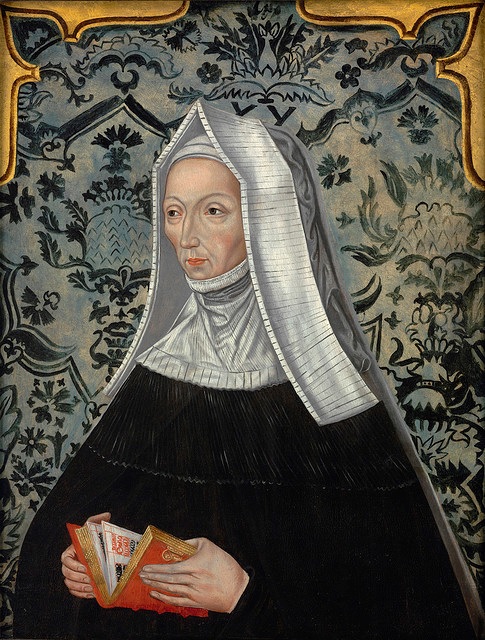
How very ironic that Queen Anne's train was carried by the woman who would play a huge part in the downfall of Richard. What was Margaret Beaufort, the Countess of Richmond, thinking that day as she walked behind Anne? Was she thinking of her only child, Henry, and how he should have been there instead?
Was Margaret Beaufort a pious woman or a schemer? She is known to have taken Richard's Book of Hours from his tent at the battle scene and kept it for her own.
It must have been a wonderful occasion at the time and, with the peerage all attending, does that indicate widespread support? Maybe only as appearances go. There were undoubtedly still rumours circulating about the Princes and Richard's quick takeover.
Contemporary Illumination from the Rous Roll
Richard and Anne's son, Edward, was about 9 years old at this time and was not present at the ceremony. Some say he was a delicate child and his ill health prevented him from attending. Only a few short months later, he would be dead, and Queen Anne, too. Richard would have no legitimate heirs to pass on the crown, leaving him open for the conflict to come.
Today I am giving my first presentation on this King and my experiences as outlined in this blog and the public library. Although I lived through the Reinterment week and have studied Richard for some months now, I feel I know him less than when I started. He and his times are so very complicated. Motivations are lost in history and some things we might never know about what he did and why, or even if he did them.
History is like that, slow to reveal its secrets, and that is the fascination for many of us. No wonder we are addicted to the search!
I reported in an earlier post about how I managed to acquire some free tickets to a fabulous medieval music concert, with music from the time of King Richard. I have not yet, however, told you how it was!
The concert, sponsored by the Ricardian Music Guild, was performed by a group called Aitone: The Early Music Consort. This group, formed in 2005, is based in the east Midlands town of Long Eaton. They perform a capella and sing music from the 10th to the 18th centuries, including Anglo-Saxon chant, West Gallery psalmody, medieval English discant, and Renaissance madrigals.
At this particular concert, they were joined by an American musician, Susan Burns from Charlotte, North Carolina. She played several recorders for a few of the songs.
Several songs stuck out for me in the programme. I have found some YouTube recordings of them. Although they are not identical to the performance I heard, they will give you an idea of what was in vogue musically during the time of King Richard III.
The first song I especially enjoyed was called Bryng Us in Good Ale which was a chorus sing-along. It is a drinking song, and it was great fun to try to sing along.
I also enjoyed Trotto, a quick Italian dance, which I have heard many times:
Ecce Quod Natura, a lovely carol from a Leicester manuscript, describes the mystery of virgin birth from a Nature-turned-upside down perspective.
Hay! Mary, Ful of Grace is another nice carol from St. Mary Newarke, Leicester. It continued to be popular for many years later, still being published in 1550.
One last one that I enjoyed was called Lully Lulla: Thow Littel Tine Child. Here is a very nice version:
Interspersed between songs was some description, interpretation, and history about the music we were to hear. This was quite helpfully provided by Dr. Tony Bentley from the University of Leicester. In the programme notes, I learned that he is also a 1st cousin 15x removed from King Richard, so he is one of my cousins, too!
Overall, the concert was very lovely. The only downside was the intermission, when people left the church itself to go out for a tea break. It took a longer time to get them back again than was expected, and I was ready to hear the music again!
In a previous post, I looked at portraits of Richard himself, all done some years after his death.
I have also been thinking of how Richard has been portrayed by others, mostly in that play by William Shakespeare. I don't want to bad-mouth the play since Will Shakespeare is also my cousin (1st cousin 15x removed through his mother's family), and there are some very fine speeches in it.
One of my favourites speeches makes Richard look a complete bad guy, the Epitome of Evil:
"But then I sigh, with a piece of Scripture
Tell them that God bids us to do evil for good;
And thus I clothe my naked villainy
With odd old ends stolen out of Holy Writ;
And seem a saint, when most I play the devil." Richard III, Act 1, Scene 3
Of course, this play was written during the height of the Tudor dynasty, and so there was no chance for Richard to ever be made to look good.
I was recently at the Art Institute of Chicago and visited their latest special exhibit, Ireland: Crossroads of Art and Design, 1690-1840, when what should I see:
Mr. Garrick as Richard III
by John Dixon, 1772
David Garrick by my favourite artist,
Thomas Gainsborough
David Garrick, the famous English actor, playwright, theatre manager, and producer, died in 1779, so this portrait was completed soon before his death. His appearance in Richard III was his most famous role.
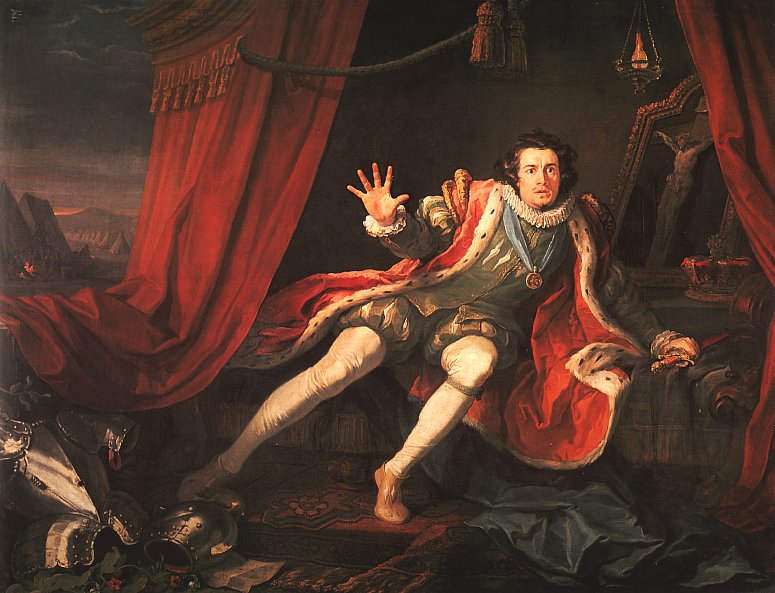
David Garrick as Richard III,
by William Hogarth, 1745
Another famous portrait of Garrick as Richard III was by his friend and famous artist, William Hogarth. This painting depicts a dramatic moment in the play on the eve of the Battle of Bosworth, in which Richard wakes up from a dream in which he has seen the ghosts of his murder victims.
I've been thinking of other famous portrayals of Richard III in Shakespeare's play that have coloured our opinion of him.
John Philip Kemble as Richard III
Painted by William Hamilton, 1783
Another famous actor who portrayed Richard was John Philip Kemble. This painting shows Richard in the play at the same moment as Hogarth's Garrick portrait, on the eve of the Battle of Bosworth, horrified by the dream images of his victims. But it is too late to redeem Richard.
John Philip Kemble (1757-1823), was a famous Shakespearean actor from a remarkably famous theatrical family. His sister was Sarah Siddons, the renowned actress of Drury Lane, painted by many of the era's foremost painters including Thomas Gainsborough, Sir George Reynolds, and . This is what
John Philip Kemble by artist
William Beechey, 1798-1799
Here is another famous painting of an actor portraying Richard:
Bogumil Dawison as Richard III
Painted by Friedrich von Amerling, 19th Century
This is an interesting portrait. The costume is unique, with the unusual headdress crown and the rich brocade on the cloak or coat, but what strikes us immediately is the scowl on the subject's face. It looks like Mr. Dawison is looking down slightly to make his brow more pronounced, a look of condescension and malignant plotting.
What do we know about this actor? Bogumil Dawison was born in Warsaw of Jewish parents in 1818. He went on stage at age 19. He was considered to be a "new type" of actor in Germany during his career, giving his roles more character and vivacity than had been seen before. He died in 1872.
One thing I notice from all of these portraits is that none of them has made Richard look particularly hunchbacked or malformed, although it is obviously part of the play. Perhaps this feature of Shakespeare's Richard was not emphasised in performances?
There have been several more modern portrayals of Richard III that have become famous. I think Sir Ian McKellen in the 1995 modernised film adaption springs to my mind first. This version, set in a fascist version of England in the 1930s, is brutal to Richard as a character. His manipulation of all around him is clear, Ian McKellen is brilliant in the part: sincere yet sneaky, painstakingly plotting, and by the end, we are glad that he's dead.
You can watch the entire film here:
Of course, nobody could forget the greatest modern Shakespearean actor, Sir Laurence Olivier. Besides his landmark roles as Hamlet and Henry V, he also portrayed King Richard in 1955. The costuming is lovely (authentic, I'm not sure), and his "This is the winter of our discontent" speech is unsurpassed in the history of this play, I feel. Richard in this example is portrayed as quite hunched back and having a withered arm, a malady I don't believe Richard had. Why the director gave it to him, I'm not sure, other than to increase our believability in his warped resentment of his physical condition and his malicious grudges of those around him. It's easier to dislike a maimed monster than a man with a slight hunch who is merely misunderstood.
The film is available on YouTube:
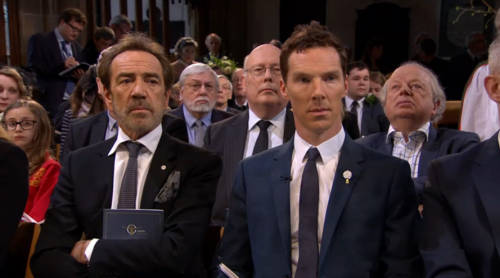
The last actor I will mention is one who played him in a 1998 production for the Royal Shakespeare Company and was also at the Reinterment, Robert Lindsay. He did not receive the most flattering reviews for his performance as the evil King. I don't know if he deserved the harsh reviews, but I certainly have enjoyed watching him in other period roles and wouldn't mind seeing him in his Richard III role.
Robert Lindsay as Richard III
Robert Lindsay & Benedict Cumberbatch
at the Royal Reinterment of King Richard


 I have been fortunate myself to have been involved in the activities surrounding the Folio's arrival, events, and viewing. The Shakespeare at Notre Dame staff have been phenomenal in their plans and just being allowed to participate in them has been one of my biggest honours, next to the Reinterment, of course.